Freedom of speech made progress in Japan this week as six theaters stood their ground and agreed to start showing "The Cove" movie beginning July 3. Several cetacean species stand to benefit from a rise in public awareness about dolphin slaughter in Japan's village of Taiji: more than 20,000 bottlenose dolphins, pilot whales, porpoises and Risso's dolphins are routinely slaughtered for meat and sold to the Japanese public or captured for use in aquariums.
Ric O'Barry, who trained dolphins for the television series 'Flipper," is campaign director for Save Japan Dolphins, featured in the film. He and his team of activists have been at this for years and are making great progress, but they still need our help. According to O'Barry, most of the Japanese public isn't aware of the brutal slaughter in Taiji.
Would you like to be part of the wave that helps this campaign reach the tipping point? If so, please sign the letter below!
Thursday, June 24, 2010


Tuesday, June 22, 2010
Gulf of Mexico Wildlife Casualty Update
 |
| Credit Tyler Karaszewski |
June 22 was Day 63 of the Gulf of Mexico oil spill and the wildlife death toll that has been recorded is: 957 birds; 387 sea turtles; 47 marine mammals. Obviously these are only the numbers that the NOAA and the wildlife rescue organizations in the gulf have managed to record. Countless other species up and down the food chain have been decimated.
I'm all for a balanced work/life ethic, but President Obama spent the weekend golfing and BP CEO Tony Hayward, staying true to his earlier comment about wanting his "life back," spent the weekend yachting in British waters.
Perhaps even the CEO of BP deserves a day off, but to publicly engage in a water sports activity truly shrieks "I don't CARE" from across the channel, no? Talk about adding insult to injury! In any case, it was a clear demonstration of either his insensitivity or his indifference to the magnitude of suffering by the oil spill victims: humans and animals alike.
Perhaps even the CEO of BP deserves a day off, but to publicly engage in a water sports activity truly shrieks "I don't CARE" from across the channel, no? Talk about adding insult to injury! In any case, it was a clear demonstration of either his insensitivity or his indifference to the magnitude of suffering by the oil spill victims: humans and animals alike.
We are the solution, dear friends. If you would like to do something to help right NOW, here are a few immediate ways you can help both animals and humans in the gulf immediately:
1) Text "NWF" to 20222 to donate $10 to the National Wildlife Federation.
2) Call 1-866-404-5826 to donate to the United Way Gulf Recovery Fund, which provides emergency assistance, including food, rent and utilities now.
3) Text COAST to 50555 to donate $10 to the Nature Conservancy.
We've all felt helpless at one point or another and there's no end in sight. Let's stick together and take action. Let's vow not to be helpless. Let's stop looking up the ladder of command for answers. We can be the solution in numbers.
Wednesday, June 16, 2010
Jay Holcomb Named Ocean Hero for 2010
 |
| Before and After Oiled Brown Pelican Credit IBRRC |
Sticking to the mission of this blog, let's focus on the positive and celebrate the organizations that are performing holy work to save wildlife, one creature at a time. I've got a soft spot for the International Bird Rescue Research Center (IBRRC) because their work is so painstaking - it can take more than one hour to clean just one bird. Jay Holcomb, IBRRC's executive director, is leading the center's rescue work in the gulf and was recently named Oceana's Ocean Hero for 2010. Oceana, an international organization focused solely on ocean conservation, created the contest in 2009 to recognize individuals making a difference for the ocean and winners are announced on World Oceans Day.
 |
| Jay Holcomb (left) and the IBRRC team Cleaning an Oiled Bird Credit IBRRC |
Bless your heart, Jay. Thanks for providing a beacon of hope during this horrific crisis. We salute you!
Thursday, June 10, 2010
Mucking through the Oil Spill
 |
| © Jenny Rollo |
I'm confused about the government's response to the oil spill. I'm also perplexed by the way BP handles (or doesn't handle) the media, though in some ways I also find it reassuring: "Sorry Anderson, we're busy plugging a hole at the moment. We'll have to get back to you." Maybe it's just that simple.
More likely, BP knows and has known from the beginning just how grave the magnitude of this event is and decided early on that to say anything would be to unleash total mayhem. Let the locals and then the world digest this mess one tragic day at a time.
I do feel for the local fisherman and their families. And what about the BP employees who lost their lives? It's kind of sad how little we've heard about them throughout this disaster. Meanwhile, the wildlife disaster unravels before our eyes and the fact that it's spawning season makes the situation even worse. So. What is being done to help the various species? Which organizations are involved? And most importantly, what can we do to help? After denial, comes action. I speak for myself, so forgive me if you already jumped in weeks ago!
 |
| Oiled Brown Pelican Marie Travers/IBRRC |
Want to volunteer? You can register to help out with the oil spill recovery! The Louisiana Gulf Response volunteer program will contact you based on their needs. Want to make a contribution? Donate whatever you can now for the oil spill recovery effort.
Wednesday, May 26, 2010
Spillin' bout' da Spill
 |
| AP Photo/Gerald Herbert |
The first thought that struck me when I heard about "the spill" was that we've left the keys to the planet on the kitchen counter and the teenagers made off with them. I dunno. Call me naive, ignorant, whatever you want. If we can't guarantee that disaster of this level will not happen, then we shouldn't be drilling at all.
I mean, here I was, obsessing with Andie MacDowell about all of our garbage and trying to shed some more light on the Great Pacific Garbage Patch and now this. Now all I can picture is a horrifying Sci Fi film where Patch meets Spill. Wait a minute...polypropylene absorbs oil! This could be a match made in heaven!
For information about the impact of the oil spill on marine mammals and sea turtles, visit the NOAA website for daily updates. To donate $10 to support Gulf wildlife now, Text "WILDLIFE" to 20222.
Monday, May 24, 2010
Marine Debris Starts with You and Me?
 |
| Abagnale Entangled in Fishing Wire Credit Marie DeStefanis |
Abagnale's story has a happy ending. The Marine Mammal Center finally caught up with him at Moss Landing, about 15 miles north of Monterey. His rescue was intense, with crew both in the water and on land, but their efforts finally paid off. Using darts with a mild sedative, the team rescued Abagnale on January 24th and took him to the Center, where he stayed for about 13 days, while he received top-notch medical care for his wounds and snarfed 100 pounds of herring. He was released on February 4th and has since been spotted at Moss Landing, looking good.
 | |
| 450 lbs of fishing net found inside a dead Sperm Whale at Tomales Bay, CA 2008 / Credit The Marine Mammal Center |
We have so much to think about. How do we recycle properly? How much of the plastic we recycle actually gets recycled? What happens to the rest of it? What do those numbers inside the triangle on plastic "recyclables" actually mean? How does our garbage end up in the ocean? What about the trash that washes up on our beaches? How does this relate to the giant Pacific Garbage Patch? How does this affect marine life? And what is being done to stop more trash from flowing into the ocean? Which organizations are watching out for wildlife and making a difference? More on this topic later. Must sleep.
Friday, May 21, 2010
Still Hissing After All These Years!
Meet Gigi. She's a rescue who was feral when I got her in 2004 and after six years of "working with her," she still hisses at me as I hand her a dish of food. Some of my friends can't believe I enjoy having a pet like Gigi, but I find it hilarious that she hisses at the hand that feeds her. How very feline!
I have always been partial to animals with special needs and I like having a wild animal in the house. She lumbers out from under the bed, where she spends most of the night and half the day, and races for the living room sofa where I'm sure to keep a nice big blanket waiting, so she can dive bomb under that and hide some more.
She makes strange warbling sounds like a tree animal and never looks me in the eye. She is also the best snuggler of any cat I've ever met. Whenever I have trouble sleeping, all I have to do is pick her up and hold her for a few minutes and we both fall asleep instantly! I'm very clear that she was not put here to entertain me. We cohabitate. And when she hisses and disses the hand that feeds her, I never take it personally.
 |
| Gigi / Planet Blanket Photo by Nancy Whelan |
I have always been partial to animals with special needs and I like having a wild animal in the house. She lumbers out from under the bed, where she spends most of the night and half the day, and races for the living room sofa where I'm sure to keep a nice big blanket waiting, so she can dive bomb under that and hide some more.
She makes strange warbling sounds like a tree animal and never looks me in the eye. She is also the best snuggler of any cat I've ever met. Whenever I have trouble sleeping, all I have to do is pick her up and hold her for a few minutes and we both fall asleep instantly! I'm very clear that she was not put here to entertain me. We cohabitate. And when she hisses and disses the hand that feeds her, I never take it personally.
Video issues with Blogger and YouTube
Starting this evening, I noticed that certain video clips appear on my blog as black frames. I found an online forum discussing it, but no fix yet. Looking for the answer.
Wednesday, May 19, 2010
Writing for CoastViews Magazine

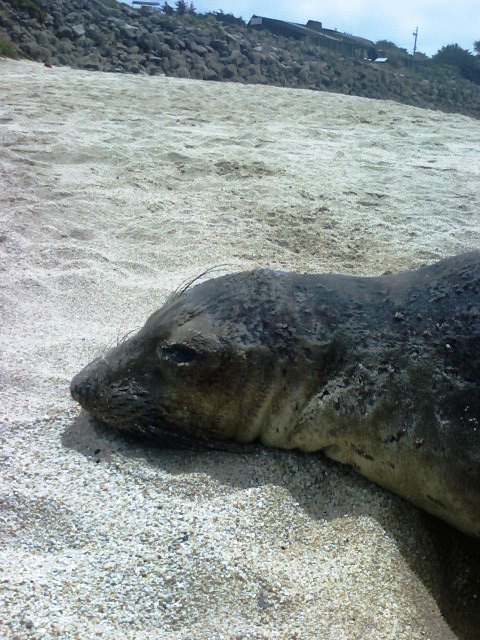
As a volunteer for the Marine Mammal Center, I have heard many stories about caring individuals like you and me, who walk right up to stranded sea mammals, allowing their dogs to approach the animal as well. It's an anomaly for most of us to encounter a marine mammal at all, so imagine how the seal feels encountering a human and a dog! Don't get me wrong - I'm not getting up on my high and mighty about this - I am a wildlife enthusiast, a nature lover and a take charge kind of person - as well as a writer - all reasons why I'd probably do the same thing, if it weren't for the Marine Mammal Center's training and incredible devotion to community outreach.
 | |||
| Northern California Elephant Seal Photo by Nancy Whelan |
I called in my assessment to the Center's Rescue Hotline and was relieved to learn that I was wrong about one thing: this seal was not dying. She was experiencing catastrophic molt, basically losing hair and a layer of skin, and her lethargic behavior was perfectly normal.
 | |||
| Elephant Seal Montara State Beach May 7, 2010 Photo by Nancy Whelan |
I tried to be as quick as I could, but I wanted a closeup of her right side, which seemed to have some lumps. This animal had a green "X" on her rump, marked by a previous volunteer who had checked on her the week before.
I got another call from the Center on May 8 - this time to assist with a rescue of the same seal. Based on other photos I had submitted, the Rescue Team decided this animal needed to see a veterinarian. However, when I arrived at Montara State Beach, the seal had gone back out to the ocean. Understandable. This was a Saturday and the beach was dotted with people and dogs. Can't a poor girl get a little rest? As of today, this seal has not re-stranded.
Friday, May 14, 2010
"SEAL" Training for Wildlife Enthusiasts!
 | |||||||||
| Marine Mammal Center Volunteer Training Rodeo Beach, February 7 2010 |
I was also struck by how useful the Marine Mammal Center's training materials could be for families living along the California coast. Volunteers were treated to slide after slide of each pinniped species, and the narrative input from the Center's experts further helped us to identify characteristics and behaviors unique to each species.
It occurred to me that families along any coast have a unique role to play in helping marine mammals survive and thrive. We share our beaches with these glorious creatures, and they bring us important news bites from the sea that reveal the current health of our coastal waters. It is not lost on me that the Marine Mammal Center saves these animals on a regular basis, but in turn, as we learn details from the Center's research, we are equipped with the information we need to save ourselves.
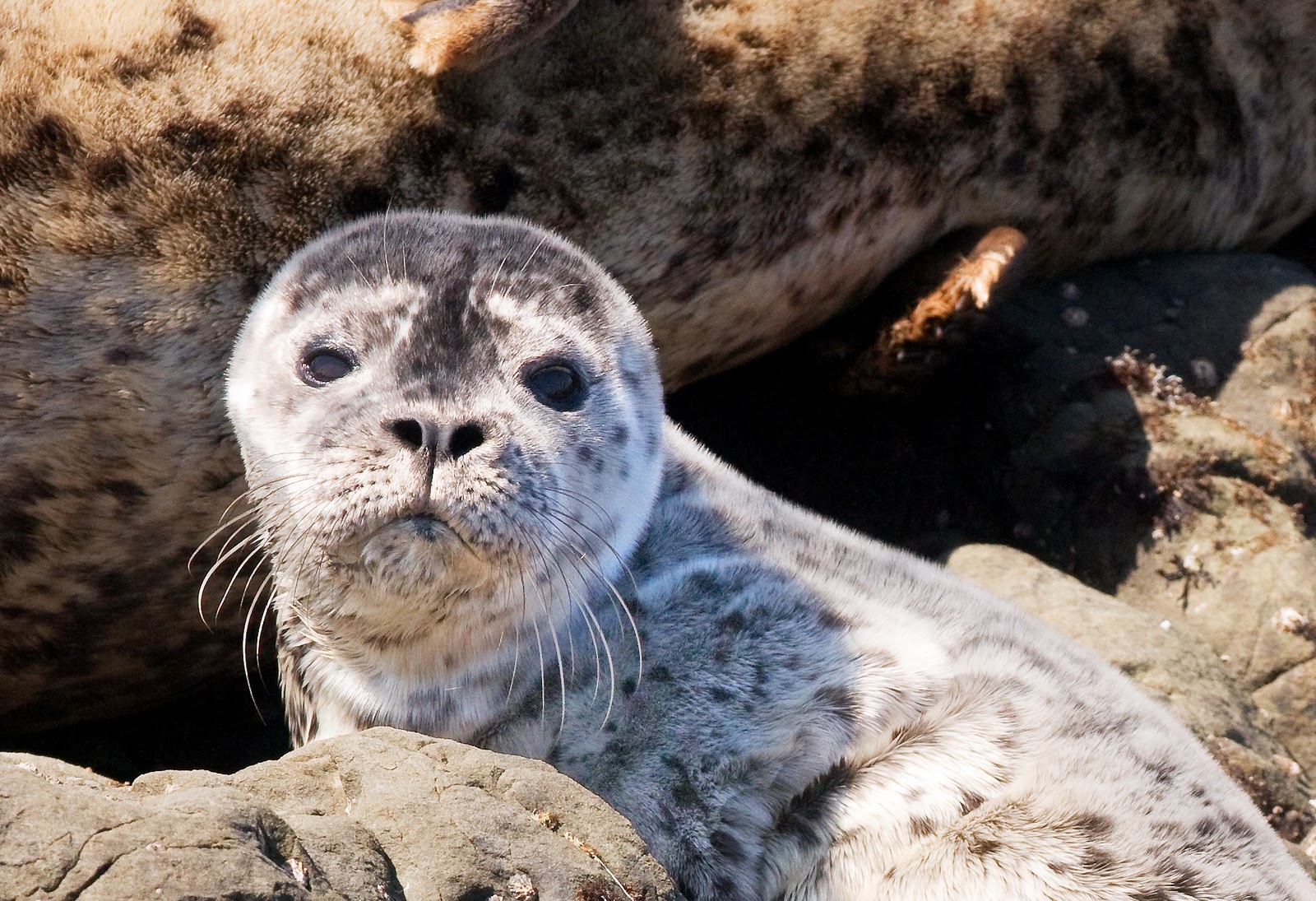 |
| Young Harbor seal pup / Credit Stan Keiser |
If it is not certain that an animal requires veterinarian care, the Marine Mammal Center will place that animal under 24-hour observation to try to learn more about its condition. But if an animal looks malnourished or stressed, all one has to do is call the Marine Mammal Center Hotline at 415.289.SEAL and the Center will dispatch one of their trucks and conduct a rescue. The Marine Mammal Center's rescue range extends along 600 miles of central and northern California coastline, from San Luis Obispo through Mendocino County.
Would that all wild animals had such wonderful care!
Subscribe to:
Posts (Atom)


