Showing posts with label animal rescue. Show all posts

Friday, May 14, 2010

"SEAL" Training for Wildlife Enthusiasts!

Marine Mammal Center Volunteer Training
Rodeo Beach, February 7 2010


After more than two years of trying, in February I finally managed to attend a day-long training session to become a stranding volunteer for the Marine Mammal Center. I was so impressed by the level of commitment and enthusiasm demonstrated by the Center's volunteer training staff that I silently vowed to help them for the rest of my life, both as a volunteer and a journalist.

I was also struck by how useful the Marine Mammal Center's training materials could be for families living along the California coast. Volunteers were treated to slide after slide of each pinniped species, and the narrative input from the Center's experts further helped us to identify characteristics and behaviors unique to each species.

It occurred to me that families along any coast have a unique role to play in helping marine mammals survive and thrive. We share our beaches with these glorious creatures, and they bring us important news bites from the sea that reveal the current health of our coastal waters. It is not lost on me that the Marine Mammal Center saves these animals on a regular basis, but in turn, as we learn details from the Center's research, we are equipped with the information we need to save ourselves.
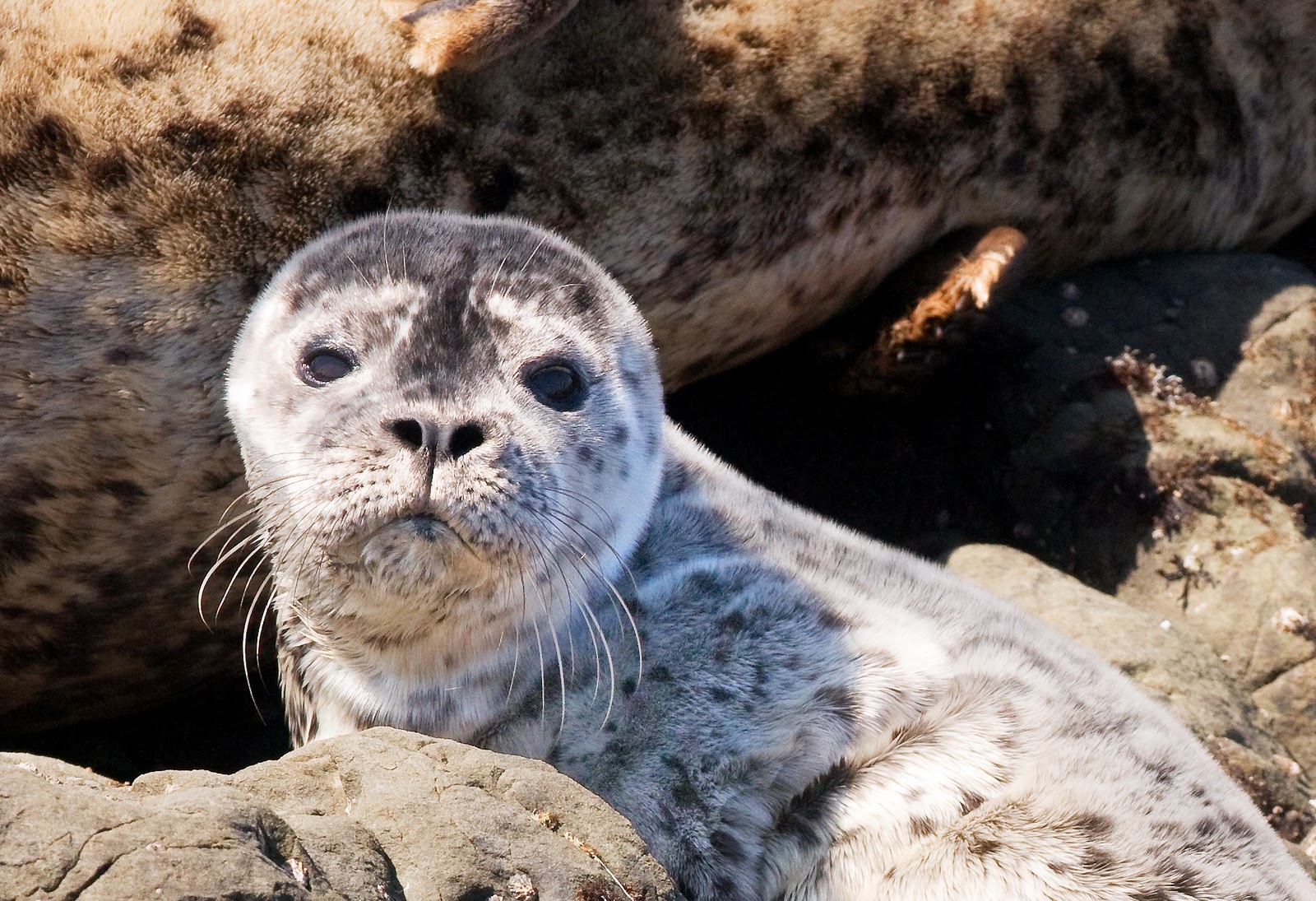
Young Harbor seal pup /
Credit Stan Keiser
When a marine mammal strands on the rocks or on the sand, it's critical to keep our distance since "hauling out" is a natural behavior for certain species. However, here on the California coast, we are blessed to have a marine mammal "swat team" always on the ready to jump in and perform a rescue if necessary. The Center frequently dispatches volunteers (like me) to go out and observe a stranded animal, to determine whether a full-blown rescue is necessary. The goal is always to minimize disruption of the animal's natural environment and conduct a rescue only if it is determined that the animal is suffering.

If it is not certain that an animal requires veterinarian care, the Marine Mammal Center will place that animal under 24-hour observation to try to learn more about its condition. But if an animal looks malnourished or stressed, all one has to do is call the Marine Mammal Center Hotline at 415.289.SEAL and the Center will dispatch one of their trucks and conduct a rescue. The Marine Mammal Center's rescue range extends along 600 miles of central and northern California coastline, from San Luis Obispo through Mendocino County.

Would that all wild animals had such wonderful care!

Monday, November 16, 2009

Tax-Deductible Charitable Contributions for Wildlife

Snow Leopard / Credit WWF
46 days left in 2009 to select a worthwhile cause and make a difference for your favorite species (including humans)! Consider the difference it will make if every one of us contributes even 1 dollar to a struggling nonprofit organization. 

Keep in mind that charitable contributions are tax-deductible in the U.S., if you itemize deductions on Form 1040 (Schedule A).

If you like the idea, but you're not sure where to begin, check out the World Wildlife Fund website, where you can adopt a species, buy a gift adoption card or shop hand-crafted gifts that support sustainable livelihoods for indigenous peoples.

Keep in mind that charitable contributions must be made to qualified organizations in order to be deductible.

For more information on tax deductions and charitable contributions, visit IRS.gov.

Tuesday, October 27, 2009

Animal Rescue Organizations Battle Massive Algae Bloom

Birds awaiting transport
Credit IBRRC
Animal rescue organizations are rallying to save various marine species in the face of a catastrophic case of algal bloom along the West coast. Today, more than 300 migratory seabirds from the Oregon/Washington coast were airlifted by the US Coastguard and delivered into the helpful hands of volunteers from the International Bird Rescue Research Center. Unfortunately more than 1,000 birds have already died, as the slimy foam caused by the algae permeates their feathers, robbing them of their water resistance, causing hypothermia and eventually starvation. Scientists have referred to the algal bloom as “natural” but admit they aren’t sure whether it might be occurring also due to unnatural causes.

The plight of the birds is not the first we’ve heard about algae bloom on the west coast this year. Marine mammals, mostly sea lions, have been washing up along the California shore all summer long. I’ve witnessed it myself several times this summer, on walks near Half Moon Bay, where I’ve encountered as many as six dead yearling sea lion pups during one short walk. The Marine Mammal Center has treated an unprecedented number of sick and injured animals this year, roughly 1500, many of them suffering from domoic acid poisoning, a type of algal bloom that gets into the animals’ food chain and causes brain damage.
A red throated loon gets washed and  rinsed
Photo: Paul Kelway/IBRRC
If our first concern is to relieve and hopefully stop the horrific suffering of these birds and animals up and down the West coast, our second question has to be “what does this mean for us humans?” This year’s campaign over at the Marine Mammal Center is “Save Our Seals, Save Ourselves,” a message designed to remind the public of our direct connection to nature.

The International Bird Rescue Research Center and the Marine Mammal Center both need our help desperately to continue with their heroic operations. Hats off too, to the US Coast Guard and to the hundreds of volunteers who give their time and energy to these organizations.

For more information about how to help, please visit the Marine Mammal Center and the International Bird Rescue Research Center Web sites.

Thursday, June 4, 2009

Honoring Alexis Ells and her Equine Sanctuary

I've never met Alexis Ells but she's my hero. Here is a case of humans rescuing animals rescuing humans. That's right. Here's how it works:

Ells founded the Ojai, California-based nonprofit The Equine Sanctuary in 2001 where she rescues and rehabilitates injured race horses or "performance horses" that can no longer compete. She and her team have rehabilitated thousands of horses that would otherwise have been euthanized. Most of these horses get placed with new owners who give them a good home (or pasture) to live out their lives.

Many of the horses at The Equine Sanctuary have been retrained and are now working with physically disabled children via the sanctuary's therapeutic riding program.

Who is saving whom?