Wednesday, May 26, 2010

Spillin' bout' da Spill

AP Photo/Gerald Herbert
So... the oil spill. Having just completed an article about marine debris, with the leading culprit as plastic, I've remained inexplicably silent about the 5,000 gallons of crude oil that have been pumping into the Gulf of Mexico for the past 30 days and counting. What this disaster means to Gulf of Mexico wildlife and the environment can best be explained by photos, rather than words. The Boston Globe published a series of photos today and sliding through them, I was struck by this one of a young heron, crumpled in a soggy heap, surrounded by oil where oil should never ever be. 

The first thought that struck me when I heard about "the spill" was that we've left the keys to the planet on the kitchen counter and the teenagers made off with them. I dunno. Call me naive, ignorant, whatever you want. If we can't guarantee that disaster of this level will not happen, then we shouldn't be drilling at all.

I mean, here I was, obsessing with Andie MacDowell about all of our garbage and trying to shed some more light on the Great Pacific Garbage Patch and now this. Now all I can picture is a horrifying Sci Fi film where Patch meets Spill. Wait a minute...polypropylene absorbs oil! This could be a match made in heaven!

For information about the impact of the oil spill on marine mammals and sea turtles, visit the NOAA website for daily updates. To donate $10 to support Gulf wildlife now, Text "WILDLIFE" to 20222.


Monday, May 24, 2010

Marine Debris Starts with You and Me?

Abagnale Entangled in Fishing Wire
Credit Marie DeStefanis
The muse for my second article in CoastViews Magazine is none other than a California Sea Lion by the name of Abagnale. He was spotted by tourists on January 1 at Pier 39. It took the Marine Mammal Center Rescue Team three weeks and twenty rescue attempts to catch this animal, which is why they named him after the infamous Frank Abagnale, Jr., a 1960's con artist who always seemed to be two steps ahead of the authorities. Abagnale was entangled in monofilament nylon fishing line, which was wrapped not only around his neck, but around his muzzle. He couldn't even open his mouth to eat.

Abagnale's story has a happy ending. The Marine Mammal Center finally caught up with him at Moss Landing, about 15 miles north of Monterey. His rescue was intense, with crew both in the water and on land, but their efforts finally paid off. Using darts with a mild sedative, the team rescued Abagnale on January 24th and took him to the Center, where he stayed for about 13 days, while he received top-notch medical care for his wounds and snarfed 100 pounds of herring. He was released on February 4th and has since been spotted at Moss Landing, looking good.

450 lbs of fishing net found inside a dead Sperm Whale at
Tomales Bay, CA 2008 / Credit The Marine Mammal Center

Years ago, I read about birds getting entangled in six-pack rings, and I couldn't bear the idea that our trash was impacting wildlife. But in fact, the six-pack rings are just the tip of the iceberg. Fishing line, fishing net, plastic bags and all types of cellophane and plastic are a growing problem for marine mammals and birds, who frequently mistake plastic for food and feed it to their young.

We have so much to think about. How do we recycle properly? How much of the plastic we recycle actually gets recycled? What happens to the rest of it? What do those numbers inside the triangle on plastic "recyclables" actually mean? How does our garbage end up in the ocean? What about the trash that washes up on our beaches? How does this relate to the giant Pacific Garbage Patch? How does this affect marine life? And what is being done to stop more trash from flowing into the ocean? Which organizations are watching out for wildlife and making a difference? More on this topic later. Must sleep.

Friday, May 21, 2010

Still Hissing After All These Years!

Meet Gigi. She's a rescue who was feral when I got her in 2004 and after six years of "working with her," she still hisses at me as I hand her a dish of food. Some of my friends can't believe I enjoy having a pet like Gigi, but I find it hilarious that she hisses at the hand that feeds her. How very feline!
Gigi / Planet Blanket
Photo by Nancy Whelan

I have always been partial to animals with special needs and I like having a wild animal in the house. She lumbers out from under the bed, where she spends most of the night and half the day, and races for the living room sofa  where I'm sure to keep a nice big blanket waiting, so she can dive bomb under that and hide some more.

She makes strange warbling sounds like a tree animal and never looks me in the eye. She is also the best snuggler of any cat I've ever met.  Whenever I have trouble sleeping, all I have to do is pick her up and hold her for a few minutes and we both fall asleep instantly! I'm very clear that she was not put here to entertain me. We cohabitate. And when she hisses and disses the hand that feeds her, I never take it personally.

Video issues with Blogger and YouTube

Starting this evening, I noticed that certain video clips appear on my blog as black frames. I found an online forum discussing it, but no fix yet. Looking for the answer.

Wednesday, May 19, 2010

Writing for CoastViews Magazine

The past few months have been a time of great transition in my life. This blog has temporarily taken a back seat, but I never stopped writing about nature and animals. In February, I pitched the publisher of CoastViews Magazine on a story to inspire Coastside families to take stewardship of their local environment to help stranded marine mammals survive. The story, "Here Come the Pups Again," appeared in the April 2010 issue and focuses on the pinniped pupping season on the California Coast.

As a volunteer for the Marine Mammal Center, I have heard many stories about caring individuals like you and me, who walk right up to stranded sea mammals, allowing their dogs to approach the animal as well. It's an anomaly for most of us to encounter a marine mammal at all, so imagine how the seal feels encountering a human and a dog! Don't get me wrong - I'm not getting up on my high and mighty about this - I am a wildlife enthusiast, a nature lover and a take charge kind of person - as well as a writer - all reasons why I'd probably do the same thing, if it weren't for the Marine Mammal Center's training and incredible devotion to community outreach.

Northern California Elephant Seal
Photo by Nancy Whelan


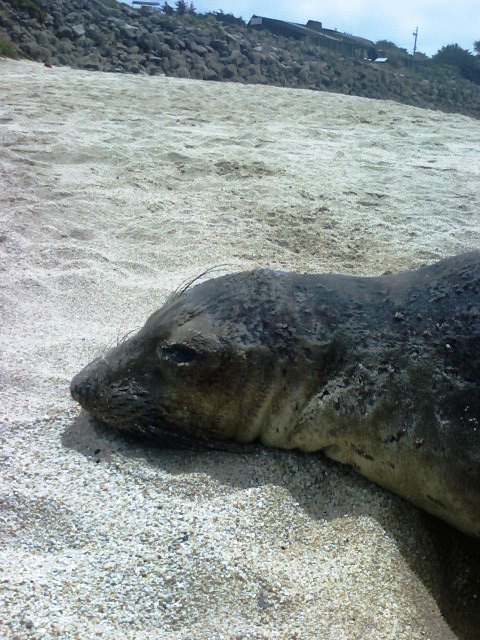
Last week, as part of my volunteer work, I went to Montara State Beach to observe an elephant seal that had hauled out on the beach. The Marine Mammal Center relies upon its volunteers along a 600-mile stretch of coast to go out and assess the condition of stranded animals.

I called in my assessment to the Center's Rescue Hotline and was relieved to learn that I was wrong about one thing: this seal was not dying. She was experiencing catastrophic molt, basically losing hair and a layer of skin, and her lethargic behavior was perfectly normal.

Elephant Seal Montara State Beach May 7, 2010
Photo by Nancy Whelan

Elephant seals generally tolerate human activity better than the other pinniped species, but I think this one finally grew a little weary of my photo taking! Graaaaa!

I tried to be as quick as I could, but I wanted a closeup of her right side, which seemed to have some lumps. This animal had a green "X" on her rump, marked by a previous volunteer who had checked on her the week before.

I got another call from the Center on May 8 - this time to assist with a rescue of the same seal. Based on other photos I had submitted, the Rescue Team decided this animal needed to see a veterinarian. However, when I arrived at Montara State Beach, the seal had gone back out to the ocean. Understandable. This was a Saturday and the beach was dotted with people and dogs. Can't a poor girl get a little rest? As of today, this seal has not re-stranded.

Friday, May 14, 2010

"SEAL" Training for Wildlife Enthusiasts!

Marine Mammal Center Volunteer Training
Rodeo Beach, February 7 2010


After more than two years of trying, in February I finally managed to attend a day-long training session to become a stranding volunteer for the Marine Mammal Center. I was so impressed by the level of commitment and enthusiasm demonstrated by the Center's volunteer training staff that I silently vowed to help them for the rest of my life, both as a volunteer and a journalist.

I was also struck by how useful the Marine Mammal Center's training materials could be for families living along the California coast. Volunteers were treated to slide after slide of each pinniped species, and the narrative input from the Center's experts further helped us to identify characteristics and behaviors unique to each species.

It occurred to me that families along any coast have a unique role to play in helping marine mammals survive and thrive. We share our beaches with these glorious creatures, and they bring us important news bites from the sea that reveal the current health of our coastal waters. It is not lost on me that the Marine Mammal Center saves these animals on a regular basis, but in turn, as we learn details from the Center's research, we are equipped with the information we need to save ourselves.

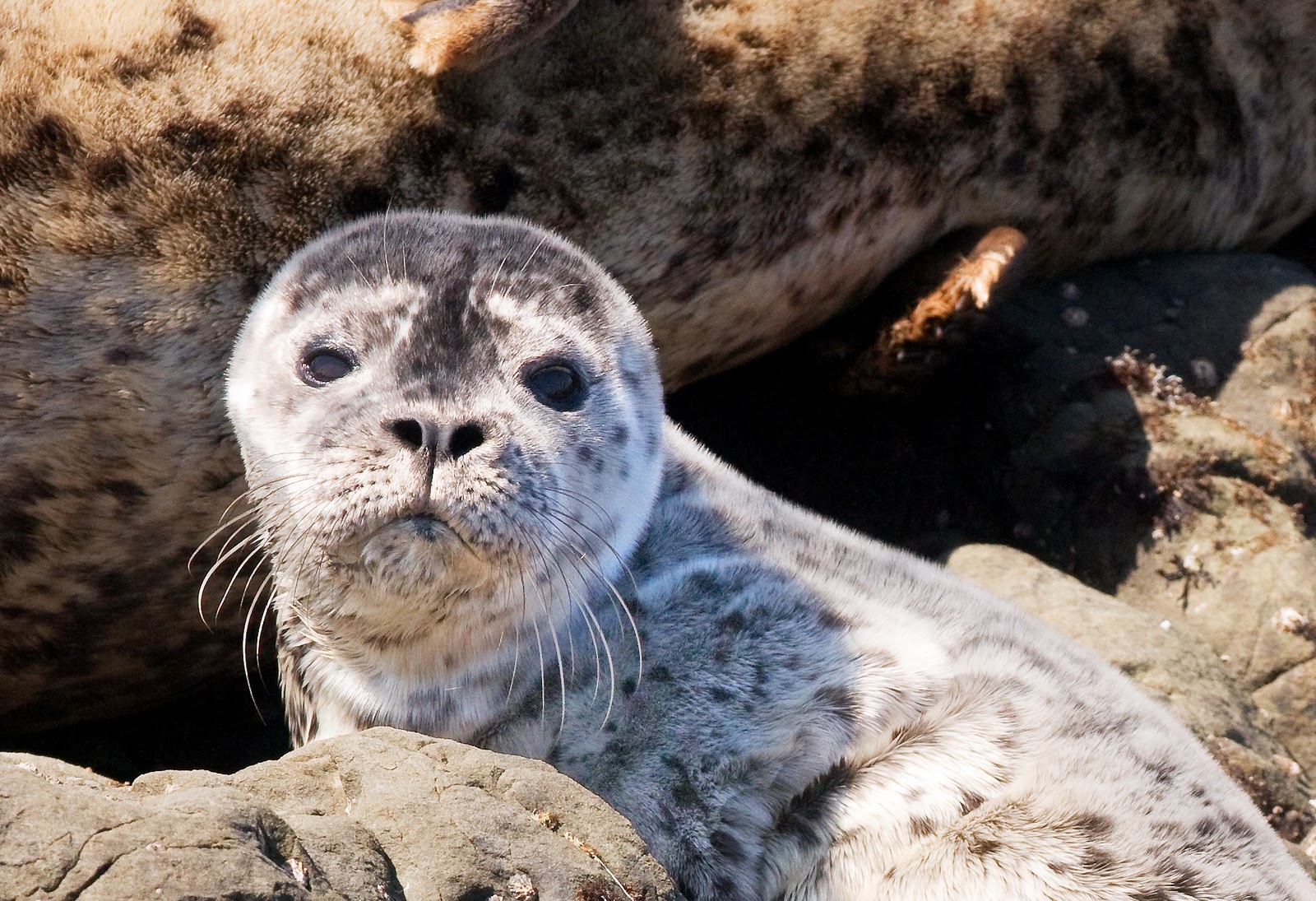
Young Harbor seal pup /
Credit Stan Keiser
When a marine mammal strands on the rocks or on the sand, it's critical to keep our distance since "hauling out" is a natural behavior for certain species. However, here on the California coast, we are blessed to have a marine mammal "swat team" always on the ready to jump in and perform a rescue if necessary. The Center frequently dispatches volunteers (like me) to go out and observe a stranded animal, to determine whether a full-blown rescue is necessary. The goal is always to minimize disruption of the animal's natural environment and conduct a rescue only if it is determined that the animal is suffering.

If it is not certain that an animal requires veterinarian care, the Marine Mammal Center will place that animal under 24-hour observation to try to learn more about its condition. But if an animal looks malnourished or stressed, all one has to do is call the Marine Mammal Center Hotline at 415.289.SEAL and the Center will dispatch one of their trucks and conduct a rescue. The Marine Mammal Center's rescue range extends along 600 miles of central and northern California coastline, from San Luis Obispo through Mendocino County.

Would that all wild animals had such wonderful care!

Monday, November 16, 2009

Tax-Deductible Charitable Contributions for Wildlife

Snow Leopard / Credit WWF
46 days left in 2009 to select a worthwhile cause and make a difference for your favorite species (including humans)! Consider the difference it will make if every one of us contributes even 1 dollar to a struggling nonprofit organization. 

Keep in mind that charitable contributions are tax-deductible in the U.S., if you itemize deductions on Form 1040 (Schedule A).

If you like the idea, but you're not sure where to begin, check out the World Wildlife Fund website, where you can adopt a species, buy a gift adoption card or shop hand-crafted gifts that support sustainable livelihoods for indigenous peoples.

Keep in mind that charitable contributions must be made to qualified organizations in order to be deductible.

For more information on tax deductions and charitable contributions, visit IRS.gov.

Tuesday, October 27, 2009

Animal Rescue Organizations Battle Massive Algae Bloom

Birds awaiting transport
Credit IBRRC
Animal rescue organizations are rallying to save various marine species in the face of a catastrophic case of algal bloom along the West coast. Today, more than 300 migratory seabirds from the Oregon/Washington coast were airlifted by the US Coastguard and delivered into the helpful hands of volunteers from the International Bird Rescue Research Center. Unfortunately more than 1,000 birds have already died, as the slimy foam caused by the algae permeates their feathers, robbing them of their water resistance, causing hypothermia and eventually starvation. Scientists have referred to the algal bloom as “natural” but admit they aren’t sure whether it might be occurring also due to unnatural causes.

The plight of the birds is not the first we’ve heard about algae bloom on the west coast this year. Marine mammals, mostly sea lions, have been washing up along the California shore all summer long. I’ve witnessed it myself several times this summer, on walks near Half Moon Bay, where I’ve encountered as many as six dead yearling sea lion pups during one short walk. The Marine Mammal Center has treated an unprecedented number of sick and injured animals this year, roughly 1500, many of them suffering from domoic acid poisoning, a type of algal bloom that gets into the animals’ food chain and causes brain damage.
A red throated loon gets washed and  rinsed
Photo: Paul Kelway/IBRRC
If our first concern is to relieve and hopefully stop the horrific suffering of these birds and animals up and down the West coast, our second question has to be “what does this mean for us humans?” This year’s campaign over at the Marine Mammal Center is “Save Our Seals, Save Ourselves,” a message designed to remind the public of our direct connection to nature.

The International Bird Rescue Research Center and the Marine Mammal Center both need our help desperately to continue with their heroic operations. Hats off too, to the US Coast Guard and to the hundreds of volunteers who give their time and energy to these organizations.

For more information about how to help, please visit the Marine Mammal Center and the International Bird Rescue Research Center Web sites.

Friday, October 9, 2009

2009 is the Year of the Gorilla

In case you haven't heard already, 2009 is the Year of the Gorilla! There are roughly 700 mountain gorillas remaining on the planet and they need our help! Because Uganda is home to about half of the total population of mountain gorillas, the Uganda Wildlife Authority has launched a fundraising program  to increase global awareness about this highly endangered species.

Check out the photos and videos of these rare animals on friendagorilla.org and add a gorilla friend to your shopping cart for US$1.00. What an easy way to make a difference on the planet! Another fun feature of this Web site is that you can track the gorilla families in the forest through GPS coordinates provided by the actual trackers that visit them daily! How cool is that?

p.s. My new gorilla friend is Obia, a nine year-old blackback. I started with him because I loved his noble, peaceful face and because his profile said he is a very curious individual. I'm working on getting his photo posted next!

Thursday, September 10, 2009

"Hope for Animals and Their World" Hits the Shelves

Dr. Jane Goodall, primatologist, internationally renowned conservationist, founder of the Jane Goodall Institute, UN Messenger of Peace and all around hero, has published a new book based on a topic dear to my heart and this blog: "Hope for Animals and Their World, How Endangered Species Are Being Rescued from the Brink."

In a world increasingly aware of environmental hazards and the resultant growing list of endangered species, we can celebrate some good news shared by Dr. Goodall and her co-author, Cincinnati Zoo Director, Thane Maynard. "Hope for Animals" recounts several animal conservation success stories about species that were once on the brink of extinction and are now making a comeback. Some of the species covered in the book include the California Condor, the American Crocodile and the Black-Footed Ferret.

The book also celebrates the heroic role that humans have played in these species reclamation success stories, a theme that is directly aligned with the purpose of this blog. Let's applaud the heroic measures taken by environmentalists to preserve the natural habitats for these species, as this is the level of commitment it will take to reverse the path to extinction for many other species in the future.

Thanks for joining me in my quest to identify and celebrate the ways humans and animals are working together to create a better planet. Sometimes the humans are rescuing the animals. Sometimes the animals are rescuing the humans. Sometimes it's not clear who is rescuing whom. I like to point out how we cohabitate and cooperate with many other species. Chalk one up for the humans this time!